Two weeks ago, an advisor posted a question on a LinkedIn comment thread:
“How far away is a world where account opening and financial planning data entry is done with AI?”
This is a perfectly rational question based on the fact that:
- There’s a new, exciting technology out there called AI; and,
- Users face laborious tasks that seem to be things AI can handle.
I replied in the comments that the question assumed that this is not already possible.
Then, the follow-up:
“Great. Who does it?”
This question perfectly illustrates the enterprise technology shift happening all around us. Let me explain.
Yesterday’s World
In yesterday’s world, there were two clearly-defined roles: vendors and buyers. Vendors identified pain points and brought products to market to address those pain points. Buyers looked for solutions they thought would help, and became users of these products.
In this world, building products was expensive. Vendors built features that satisfied the largest number of buyers. Even if they wanted to, vendors couldn’t respond to every new pain point their buyers raised. As a result, nuanced pain points remained un-addressed. Buyers’ only option was to buy more products, and the cycle repeated itself.
“Who does it?” is a question for yesterday’s world.
The New World
In the new world, there is a new role: builder. Like vendors, builders identify pain points and bring solutions to market to address those pain points. Like buyers, builders look for solutions they think will help, and become users of these products. And as you can see, the roles are no longer clear. We’ve shifted from an elegant dichotomy to a chaotic Venn diagram.
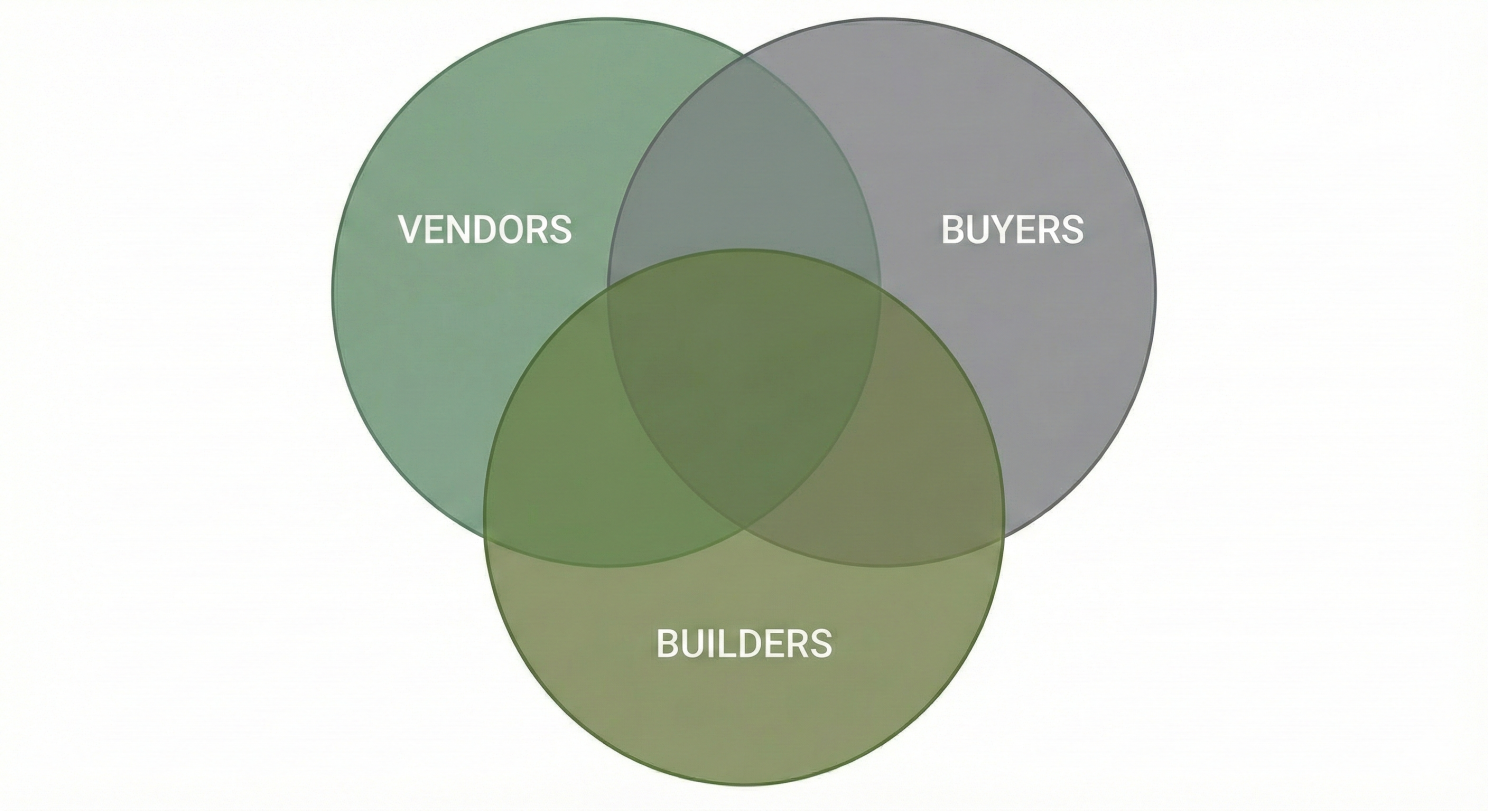
In the new world, building products is cheaper. Vendors can build more features that satisfy more nuanced buyer needs (will they? should they? These are separate questions…). In this new world, even buyers can become builders (same questions…). Using OpenAI’s Codex or Anthropic’s Claude Code, anyone can open Terminal and launch applications without calling a vendor. What’s more, these applications can use new agentic capabilities. Agentic means the apps can accomplish specific tasks while maintaining context and operating across infinite combinations of tools.
What This New World Means for Buyers and Vendors
Going back to our original inquisitor: “how far away are we from AI handling account opening and financial planning data?” The answer is: as close or far away as you wish.
In yesterday’s world, you had to wait for a vendor (in the inquisitor’s case, likely a vertical all-in-one solution) to incorporate “AI” into their platform and offer the features you need. If you wanted to accomplish certain tasks off-platform, you’d need to wait for that vendor to integrate with your other tools and systems in exactly the right way to support your needs. In other words, this was a tall order in yesterday’s world.
In the new world, you have more choices. You can:
- Switch to vendors who have a builder mentality — this means constantly shipping and supporting new features, and providing robust, accessible APIs.
- Find new AI-native vendors (some might call them builder-vendors) who increase your operational capacity, connect systems together, and bring new agentic capabilities to bear for your business.
- Become a builder and start connecting systems and applying new technology within your organization (maintenance and total cost of ownership often incur prohibitive cost and risk).
In the new builder-enabled world, the bar for incorporating new tools should be higher than ever. Does it provide measurable operational leverage? Does it integrate with existing tools and systems (at least the ones I care to keep), and make existing tools and systems work better? On the technical side, does it provide robust, accessible APIs that AI-native vendors (or even in-house builders) can use to eliminate data siloes? On the operational side, does it help me compile and manage data I can use and re-use to run my business?
The new world brings about an entirely new mindset for evaluating technology. It is less about satisfaction (“I like this product”) and more about results (“this product provides the equivalent of 2 FTE”). It is less about what it does (“offers 17 different planning templates”) and more about what it enables (“connects to my client data source so that every household has a plan”).
If you want to talk more about enterprise technology and AI in wealth management, my DMs are open.